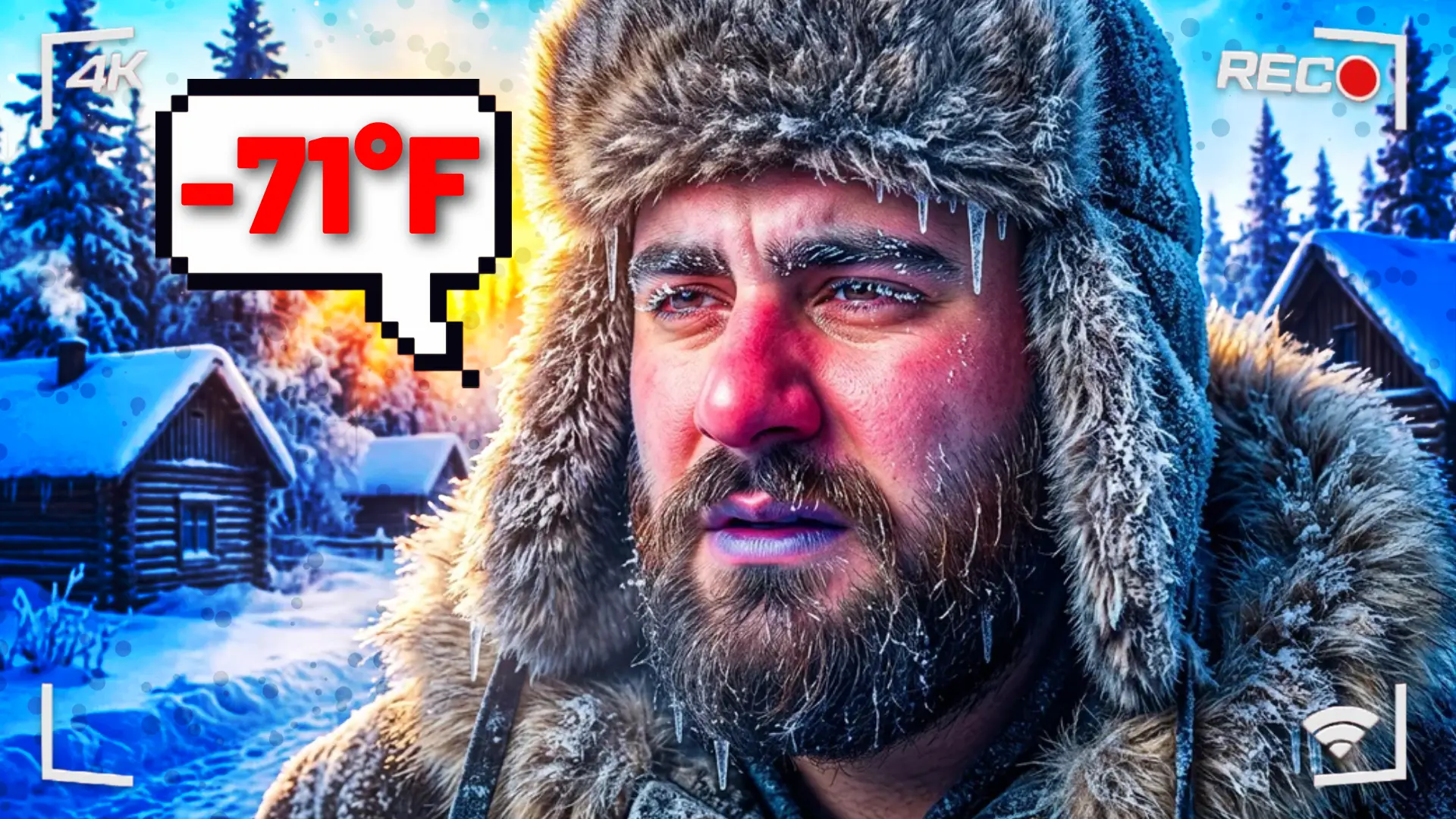
How People Survive in the World’s Coldest City (-71°C)

Documentary Overview & Investigation Notes
Detailed Research Dossier
If you step outside and take a deep, unprotected breath, the subzero air immediately attacks your lungs. With every inhale, the extreme cold chills the moisture in your airways, triggering painful spasms. Spit on the ground, and it clicks against the ice like a solid glass marble. Toss a cup of boiling water into the freezing air, and it detonates into white vapor before touching the snow. And grip bare metal with an unprotected hand, and your skin flash-freezes to the steel so violently that pulling away tears your flesh.
Locals call it the 'whisper of the stars'—a faint rustling sound heard when exhaled breath crystallizes instantly in temperatures below minus fifty.
This is not an empty Antarctic wasteland. This is a bustling modern city of over three hundred and fifty thousand people. Morning traffic is humming, cafes are packed, children grow up going to school in temperatures that can plunge below minus forty degrees, and an ancient Turkic civilization has thrived here for centuries.
How did a horseback pastoralist people from the South Siberian steppe build an enduring civilization in one of the coldest permanently inhabited places on Earth?
I'm Kayra. And today, we're stepping into one of the most extreme corners of our planet. If you're ready, let's begin.
For many, Siberia brings only one image to mind. Tsarist katorga prisons, Soviet GULAG camps, and an icy wasteland of punishment. Because of this, a persistent myth took root: that the Yakuts—or the Sakha, as they call themselves—are descendants of exiled convicts.
History tells a completely different story.
Long before Russian Cossacks reached the Lena River in the early 1630s, the Sakha had already built a thriving civilization. They forged iron. They bred vast herds of cattle and horses. And they were organized under powerful chieftains like Tygyn Darkhan. They were never penal exiles. They were the established masters of this frozen realm.
So how did an equestrian people from the southern steppe end up in the subarctic taiga?
All clues point south, toward Lake Baikal. Medieval records link them with South Siberian groups, including cultures tied to the Kurykans from early Turkic inscriptions. Around the thirteenth century, turmoil swept across Inner Asia. Ancestral Sakha groups pushed north, following the Lena River corridor.
Deep in the subarctic forest, they discovered a geographical miracle: 'alaas'. These were broad, sunken grassland basins created by thawing ground. In a sea of endless pine, they offered precious pasture for cattle and horses.
Genetics confirms this remarkable journey. Sakha DNA reveals a powerful paternal founder effect, showing a small ancestral group that expanded rapidly. At the same time, their maternal lines connect them with neighboring Siberian peoples like the Evenks and Yukaghirs.
Through generations, they integrated local survival strategies, forging a resilient subarctic society. But building a camp in the forest is one thing. Building a modern metropolis on solid ice is another.
Welcome to Yakutsk. It is the largest city on Earth built entirely on continuous permafrost.
Here, winter drops below minus sixty degrees Celsius, while summer can reach the thirties. That creates a brutal temperature swing approaching one hundred degrees. Managing that contrast demands specialized engineering.
Standard construction simply does not work. If a heated building touches the ground, its warmth thaws the underground ice. The soil turns to mud, and the structure sinks. To prevent this, engineers elevate multistory buildings on reinforced concrete piles driven deep into the frozen ground. An open space of up to two meters is left beneath the floor, letting polar air circulate and keeping the permafrost solid. Even utilities cannot be buried. Water and heating pipes run above the streets on metal pylons, wrapped in thick insulation.
Winter alters mobility rather than halting it. When the Lena River freezes solid, seasonal ice roads—known as 'zimnik'—open across the ice, carrying multi-ton supply trucks to remote northern settlements.
Yet concrete and steel can only do so much. How do living creatures survive when the air itself turns hostile?
The answer begins with a remarkable animal: the Yakut horse. Compact, stocky, and covered in an unusually dense winter coat, it lives outdoors year-round without shelter. It uses its hooves to dig through deep snow, grazing on frozen grass beneath. Genomic studies suggest that the breed underwent rapid evolutionary adaptation to the extreme cold.
Human survival required a similar ingenuity. Because agriculture is impossible during the eight-month winter, the Sakha relied on calorically dense foods that turn the cold into an ally.
Their most famous staple is 'stroganina'. River fish like muksun or chir is pulled from the water, frozen solid within minutes, and shaved into razor-thin curls. Eaten raw with a pinch of salt, stroganina delivers pure fat and protein. It is easily digestible, fueling vital thermogenesis in deep cold.
Yet surviving here took more than fat and fur. In a world where one mistake meant death, what did people believe in?
To live where nature can kill in minutes, you cannot conquer your environment. You have to respect it.
In Sakha cosmology, the universe is divided into three realms. The Upper World belongs to benevolent deities, the Aiyy. The Underworld is the domain of malevolent Abaasy spirits. Between them lies the Middle World, shared by humans and nature spirits called Ichchi. All three realms are connected by the cosmic world tree, Aal Luuk Mas.
Traditional life demanded constant respect for these spirits. Hunters left offerings for Bayanay, guardian of the forest, while shamans—Oyuun for men and Udagan for women—mediated balance. When Russian Orthodoxy arrived in the seventeenth century, it did not erase these beliefs. Instead, Christian figures and indigenous spirits intertwined, producing a unique syncretic spirituality that endures today.
Nowhere is that spirit more alive than during Ysyakh, the summer solstice festival. After nine months of dark and cold, the brief summer is a rebirth. Major gatherings, like the celebration at Us Khatyn near Yakutsk, draw tens of thousands in traditional dress. After blessings and offerings of kumis, people join hands in the Ohuokhai. Moving clockwise in a giant circular sun dance, they celebrate warmth, solidarity, and the return of light.
And despite everything Yakutia has endured, perhaps its greatest survival story isn't written in its buildings or mines. It's spoken.
The Sakha language represents an extraordinary linguistic journey. Carried thousands of kilometers north from the steppe, this conservative branch of the Turkic family preserved archaic grammatical roots while absorbing Mongolic and Tungusic influences. Centuries of isolation forged a distinctive tongue, shaped by generations of life in the Arctic environment.
The soul of this language lives in Olonkho, monumental heroic epics recognized by UNESCO as intangible cultural heritage. Traditionally performed from memory, Olonkho can take many hours to recount, blending prose, poetry, song, and dramatic performance without musical accompaniment. The storyteller shifts voices, invoking ancient warriors and cosmic spirits through vocal mastery alone. And when music does emerge, it centers on the Khomus. Crafted by blacksmiths, this steel jaw harp produces uncanny overtones that echo galloping hooves and arctic blizzards.
Today, that storytelling tradition has migrated to the silver screen. Under the banner of 'Sakhawood', local filmmakers working on modest budgets produce compelling feature films in their native tongue. Some of these low-budget films have even outperformed Hollywood blockbusters at the local box office. Winning top prizes at international festivals, they have turned Yakutia into one of Eurasia's most vibrant film industries.
Against all odds, their culture is thriving. But beneath their feet lies another reality—one that brings immense wealth, and immense friction.
Beneath Yakutia's frozen surface lies extraordinary mineral wealth: vast deposits of gold, coal, natural gas, and above all, diamonds. ALROSA, one of the world's largest diamond producers, operates extensively across Yakutia and accounts for roughly thirty percent of global rough diamond production. Yet under federal revenue structures, substantial wealth flows outward to Moscow. That leaves local authorities to balance heavy infrastructure costs, rural disparities, and the astronomical expense of heating northern towns.
In recent years, friction between periphery and center has deepened. Following the 2022 mobilization for the conflict in Ukraine, reporting highlighted a disproportionate impact on smaller communities across Siberia and the Far East. In Yakutsk, military call-ups prompted visible distress. In a rare public display of sorrow, local women gathered in the central square. They linked hands to perform a traditional circular dance, transforming an ancient ritual of unity into a quiet expression of grief and solidarity.
And now, an even greater threat looms. One that no government can control. The ground itself is giving way.
Subarctic regions are warming significantly faster than the global average, causing widespread permafrost thaw. As subterranean ice melts, the earth collapses into sinkholes and massive thermokarst craters—most famously the Batagaika slump, a colossal crater expanding year after year. Degrading ground threatens building foundations, buckles roads, and erodes riverbanks. Worse still, as prehistoric frozen layers thaw, they release stored carbon and methane, accelerating warming on a global scale.
For centuries, the story of the Sakha has not been about conquering nature, but living in balance with it. From horseback pastoralists migrating down the Lena to modern urbanites thriving atop frozen ground, they built a civilization where human life seemed impossible. But as the permafrost thaws and the modern world encroaches, the question is no longer just how they survived the cold—it is whether this fragile balance can endure what comes next.
Could you survive a winter in Yakutia? Let me know in the comments. I'm Kayra. Until next time, take care.
Academic Bibliography & Museum Archive Sources
The following primary texts, archaeological surveys, and peer-reviewed papers back the claims in this documentary:
- ================================================================================
- THE SAKHA (YAKUT) PEOPLE RESEARCH DOSSIER - ACADEMIC BIBLIOGRAPHY
- ================================================================================
- I. ETHNIC ORIGINS, ANTHROPOLOGY, GENETICS, AND KURYKANS
- [1] Tracking the Origins of Yakutian Horses and the Genetic Basis for Rapid Adaptation to Sub-Arctic Conditions - Ludovic Orlando et al. (PNAS / NCBI PMC) - 2015
- URL: https://www.ncbi.nlm.nih.gov/pmc/articles/PMC4687531/
- [2] Yakuts (Ethnographic and Genetic Overview) - Wikipedia Foundation - 2024
- URL: https://en.wikipedia.org/wiki/Yakuts
- [3] Sakha Republic (History and Geography) - Wikipedia Foundation - 2024
- URL: https://en.wikipedia.org/wiki/Sakha_Republic
- [4] Kurykans (Ancient Three Kurykans Tribal Union and Baikal Archaeology) - Wikipedia Foundation - 2024
- URL: https://en.wikipedia.org/wiki/Kurykans
- [5] Yakutian Horse (Biology, Genetics, and Extreme Cold Adaptation) - Wikipedia Foundation - 2024
- URL: https://en.wikipedia.org/wiki/Yakutian_horse
- [6] Mitochondrial DNA Evidence for Plastered Origins of the Sakha (Yakuts) - Brigitte Pakendorf et al. - 2003
- [7] Investigating the Effects of Prehistoric Migrations in Siberia: Genetic Variation and the Origins of Yakuts - Brigitte Pakendorf et al. - 2006
- [8] Origin of Yakuts: Analysis of Y-Chromosome Haplogroups (Y-DNA N1a1 Study) - Vladimir N. Kharkov et al. - 2008
- [9] Phylogeographic Analysis of Mitochondrial DNA in Northern Asian Populations - Miroslava Derenko et al. - 2007
- [10] Coalescence Analysis of Yakut Y-Chromosomal Lineages: Founder Effect and the Timeline of the Sakha Expansion - Mark Zlojutro et al. - 2008
- II. LINGUISTICS, TURKIC STUDIES, AND WRITING SYSTEMS
- [11] Yakut Language (Phonology, Morphology, and Historical Development) - Wikipedia Foundation - 2024
- URL: https://en.wikipedia.org/wiki/Yakut_language
- [12] Siberian Turkic Languages (Classification and Divergence from Common Turkic) - Wikipedia Foundation - 2024
- URL: https://en.wikipedia.org/wiki/Siberian_Turkic_languages
- [13] Semyon Novgorodov (Creator of the First IPA-Based Latin Sakha Alphabet) - Wikipedia Foundation - 2024
- URL: https://en.wikipedia.org/wiki/Semyon_Novgorodov
- [14] Über die Sprache der Jakuten (On the Language of the Yakuts: Grammar and Texts) - Otto von Böhtlingk - 1851
- [15] Die Jakutische Sprache in ihrem Verhältnisse zu den Türksprachen - Wilhelm Radloff - 1908
- [16] Dictionary of the Yakut Language (13 Volumes) - Eduard K. Pekarsky - 1907-1930 / 1959
- III. HISTORY, ARCHAEOLOGY, AND THE PENAL/EXILE SYSTEM
- [17] Tygyn Darkhan (17th-Century Sakha Tribal Chieftain and Early Russian Resistance) - Wikipedia Foundation - 2024
- URL: https://en.wikipedia.org/wiki/Tygyn_Darkhan
- [18] Wacław Sieroszewski (Polish Political Exile and Author of The Yakuts Ethnography) - Wikipedia Foundation - 2024
- URL: https://en.wikipedia.org/wiki/Wac%C5%82aw_Sieroszewski
- [19] Katorga (Tsarist Russian Penal Colony and Forced Labor System) - Wikipedia Foundation - 2024
- URL: https://en.wikipedia.org/wiki/Katorga
- [20] Gulag (Soviet Forced Labor Camp System) - Wikipedia Foundation - 2024
- URL: https://en.wikipedia.org/wiki/Gulag
- [21] Dalstroy (Far North Construction and Mining Camp Trust) - Wikipedia Foundation - 2024
- URL: https://en.wikipedia.org/wiki/Dalstroy
- [22] Kolyma Highway / Road of Bones (R504 Arctic Highway Built by GULAG Labor) - Wikipedia Foundation - 2024
- URL: https://en.wikipedia.org/wiki/Kolyma_Highway
- [23] History of the Yakut ASSR (Vol. 1: Yakutia Prior to Russian Annexation) - Aleksey P. Okladnikov - 1955
- [24] The Yakuts: Problems of Ethnogenesis and Cultural Formation - Anatoliy I. Gogolev - 1993
- [25] The Incorporation of Northeast Asia into the Russian State - Vasiliy N. Ivanov - 2003
- [26] Arctic Mirrors: Russia and the Small Peoples of the North - Yuri Slezkine - 1994
- [27] A History of the Peoples of Siberia: Russia's North Asian Colony 1581-1990 - James Forsyth - 1992
- IV. RELIGION, SHAMANISM, MYTHOLOGY, AND ORAL TRADITIONS
- [28] Olonkho, Yakut Heroic Epos - UNESCO Intangible Cultural Heritage List - 2008
- URL: https://ich.unesco.org/en/RL/olonkho-yakut-heroic-epos-00145
- [29] Olonkho (Structure and Traditions of the Sakha Heroic Epic) - Wikipedia Foundation - 2024
- URL: https://en.wikipedia.org/wiki/Olonkho
- [30] Yhyakh / Ysyakh (Summer Solstice Festival and New Year Celebration) - Wikipedia Foundation - 2024
- URL: https://en.wikipedia.org/wiki/Yhyakh
- [31] Platon Oyunsky (Statesman, Writer, and Preserver of the Olonkho Epic) - Wikipedia Foundation - 2024
- URL: https://en.wikipedia.org/wiki/Platon_Oyunsky
- [32] Traditional Beliefs of the Yakuts in the 19th and Early 20th Centuries - Nikolay A. Alekseyev - 1975
- [33] Uraankhay-Sakhalar: Essays on the Ancient History of the Yakuts - Gavriil V. Ksenofontov - 1929 / 1992
- [34] The Yakut Holiday Ysyakh: Origins and Symbolism - Yekaterina N. Romanova - 1997
- V. CLIMATE, PERMAFROST ENGINEERING, AND GEOGRAPHY
- [35] Permafrost (Thermal Mechanics, Active Layer, and Engineering Principles) - Wikipedia Foundation - 2024
- URL: https://en.wikipedia.org/wiki/Permafrost
- [36] Batagaika Crater (Permafrost Megaslump and Climate Impact) - Wikipedia Foundation - 2024
- URL: https://en.wikipedia.org/wiki/Batagaika_crater
- [37] Oymyakon (Pole of Cold and Subarctic Extreme Climate) - Wikipedia Foundation - 2024
- URL: https://en.wikipedia.org/wiki/Oymyakon
- [38] Verkhoyansk (Northern Hemisphere Cold Pole and Thermal Amplitude) - Wikipedia Foundation - 2024
- URL: https://en.wikipedia.org/wiki/Verkhoyansk
- [39] Lena Pillars (Geological Formations and Nature Park) - Wikipedia Foundation - 2024
- URL: https://en.wikipedia.org/wiki/Lena_Pillars
- [40] Fundamentals of Geocryology and Engineering Permafrost Science in Yakutia - Melnikov Permafrost Institute - 2018
- VI. DEMOGRAPHICS AND OFFICIAL CENSUS RECORDS (1897-2021)
- [41] First General Population Census of the Russian Empire 1897 (Mother Tongue Distribution in Yakutsk Oblast) - Demoscope Weekly - 1897
- URL: http://www.demoscope.ru/weekly/ssp/rus_lan_97.php?reg=81
- [42] All-Union Population Census of 1926 (Ethnic Composition of Yakut ASSR) - Demoscope Weekly - 1926
- URL: http://www.demoscope.ru/weekly/ssp/rus_nac_26.php
- [43] All-Union Population Census of 1959 (Ethnic Composition of Yakut ASSR) - Demoscope Weekly - 1959
- URL: http://www.demoscope.ru/weekly/ssp/rus_nac_59.php
- [44] All-Union Population Census of 1989 (Ethnic Composition of Yakut ASSR) - Demoscope Weekly - 1989
- URL: http://www.demoscope.ru/weekly/ssp/rus_nac_89.php
- [45] All-Russian Population Census 2020-2021 (Official Results for Sakha Republic) - Rosstat - 2023
- URL: https://rosstat.gov.ru/vpn/2020
- VII. MODERN ECONOMY, MINING, AND INFRASTRUCTURE
- [46] PJSC ALROSA (Official Corporate Portal of Russia's Diamond Monopoly) - ALROSA - 2024
- URL: https://alrosa.ru/
- [47] Alrosa (Global Diamond Mining Operations, Ownership, and Mir Mine) - Wikipedia Foundation - 2024
- URL: https://en.wikipedia.org/wiki/Alrosa
- [48] Power of Siberia (Chayandinskoye Gas Field and Export Pipeline Network) - Wikipedia Foundation - 2024
- URL: https://en.wikipedia.org/wiki/Power_of_Siberia
- [49] Russia's Diamond Colony: The Republic of Sakha - John Tichotsky - 2000
- VIII. SOCIAL/POLITICAL STRUCTURE, UKRAINE WAR, AND DIASPORA
- [50] Maksim Ammosov (Founding Statesman of the Yakut ASSR) - Wikipedia Foundation - 2024
- URL: https://en.wikipedia.org/wiki/Maksim_Ammosov
- [51] Mikhail Nikolayev (First President of the Sakha Republic) - Wikipedia Foundation - 2024
- URL: https://en.wikipedia.org/wiki/Mikhail_Nikolayev
- [52] Free Yakutia Foundation (Indigenous Rights and Anti-War Advocacy Organization) - Wikipedia Foundation - 2024
- URL: https://en.wikipedia.org/wiki/Free_Yakutia_Foundation
- [53] Women Protest Mobilization in Siberia's Yakutsk - The Moscow Times - 2022
- URL: https://www.themoscowtimes.com/2022/09/25/women-protest-mobilization-in-siberias-yakutsk-a78888
- [54] Russian Casualties in Ukraine: Regional Analysis and Indigenous Losses - Mediazona & BBC Russian - 2024
- URL: https://en.zona.media/article/2022/05/20/casualties_eng
- IX. INDIGENOUS MINORITIES, LIFESTYLE, AND TRADITIONAL CUISINE
- [55] Evenks (Evenki Demographics, Taiga Reindeer Pastoralism, and Culture) - Wikipedia Foundation - 2024
- URL: https://en.wikipedia.org/wiki/Evenks
- [56] Evens (Even Tundra Reindeer Herding and Subarctic Distribution) - Wikipedia Foundation - 2024
- URL: https://en.wikipedia.org/wiki/Evens
- [57] Yukaghir People (Ancient Paleosiberian Culture and Endangered Language) - Wikipedia Foundation - 2024
- URL: https://en.wikipedia.org/wiki/Yukaghir_people
- [58] Dolgans (Arctic Turkic Indigenous People of Taymyr and Yakutia) - Wikipedia Foundation - 2024
- URL: https://en.wikipedia.org/wiki/Dolgans
- [59] Chukchi People (Indigenous Reindeer Pastoralists of the Far Northeast) - Wikipedia Foundation - 2024
- URL: https://en.wikipedia.org/wiki/Chukchi_people
- [60] Stroganina (Subarctic Culinary Culture and Frozen Raw Fish Consumption) - Wikipedia Foundation - 2024
- URL: https://en.wikipedia.org/wiki/Stroganina
- [61] Kumis (Fermented Mare's Milk Culture in Central and North Asia) - Wikipedia Foundation - 2024
- URL: https://en.wikipedia.org/wiki/Kumis
- ================================================================================